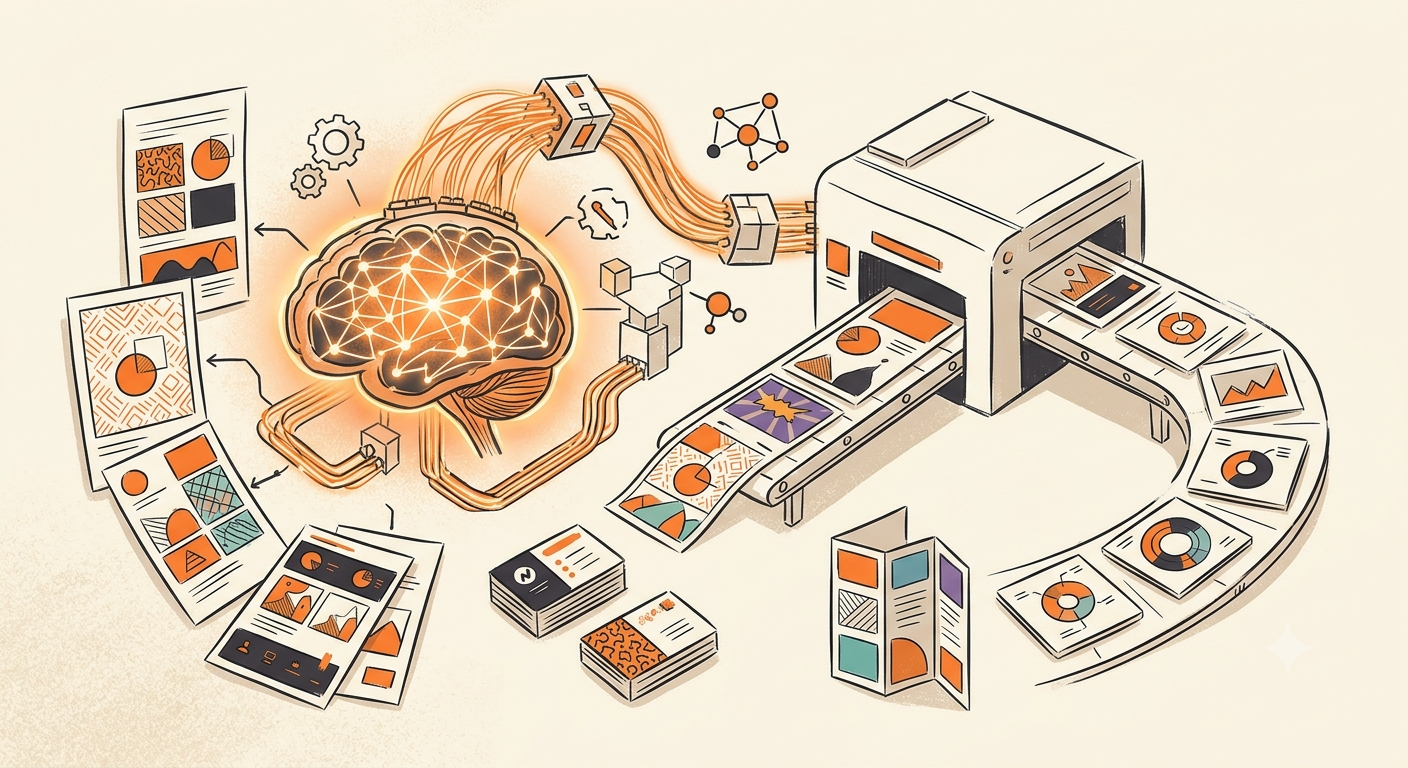
"AI is going to replace designers." You've heard this before. It's been the clickbait headline of every design publication for the past three years. And it's wrong — not because AI isn't powerful enough, but because it fundamentally misunderstands what designers actually do.
The reality is far more nuanced, and far more exciting. AI isn't here to replace the creative mind. It's here to eliminate the tedious, mechanical, error-prone 80% of the design workflow that designers never wanted to do in the first place — so they can focus on the strategic, creative 20% that actually matters.
The 80% Problem in Print Design
Ask any designer what they actually spend their day doing, and the honest answer isn't "creating beautiful things." It's more like this:
- 30% — File setup & formatting: Setting up bleed, trim marks, safe zones. Converting RGB to CMYK. Checking DPI. Adjusting margins for different print formats.
- 20% — Brand compliance checking: Pulling up the brand guide. Verifying hex codes. Matching the exact font weight. Ensuring the logo has the right clear space.
- 15% — Asset production: Resizing the same design for 8 different formats. Exporting for social, for print, for presentation. Renaming files.
- 15% — Revision cycles: "Can we try it in blue?" "The logo should be bigger." "Actually, go back to version 3." Back and forth, endlessly.
- 20% — Actual creative work: Conceptual thinking, visual storytelling, layout innovation, typography experimentation.
That last 20%? That's what designers trained for. That's what they're passionate about. That's where human creativity is irreplaceable. The other 80% is mechanical production work — and it's exactly where AI excels.
"The best designers don't want to spend their afternoon converting RGB values to CMYK Pantone equivalents. They want to solve visual communication problems. AI lets them do exactly that."
How AI Print Engines Actually Work
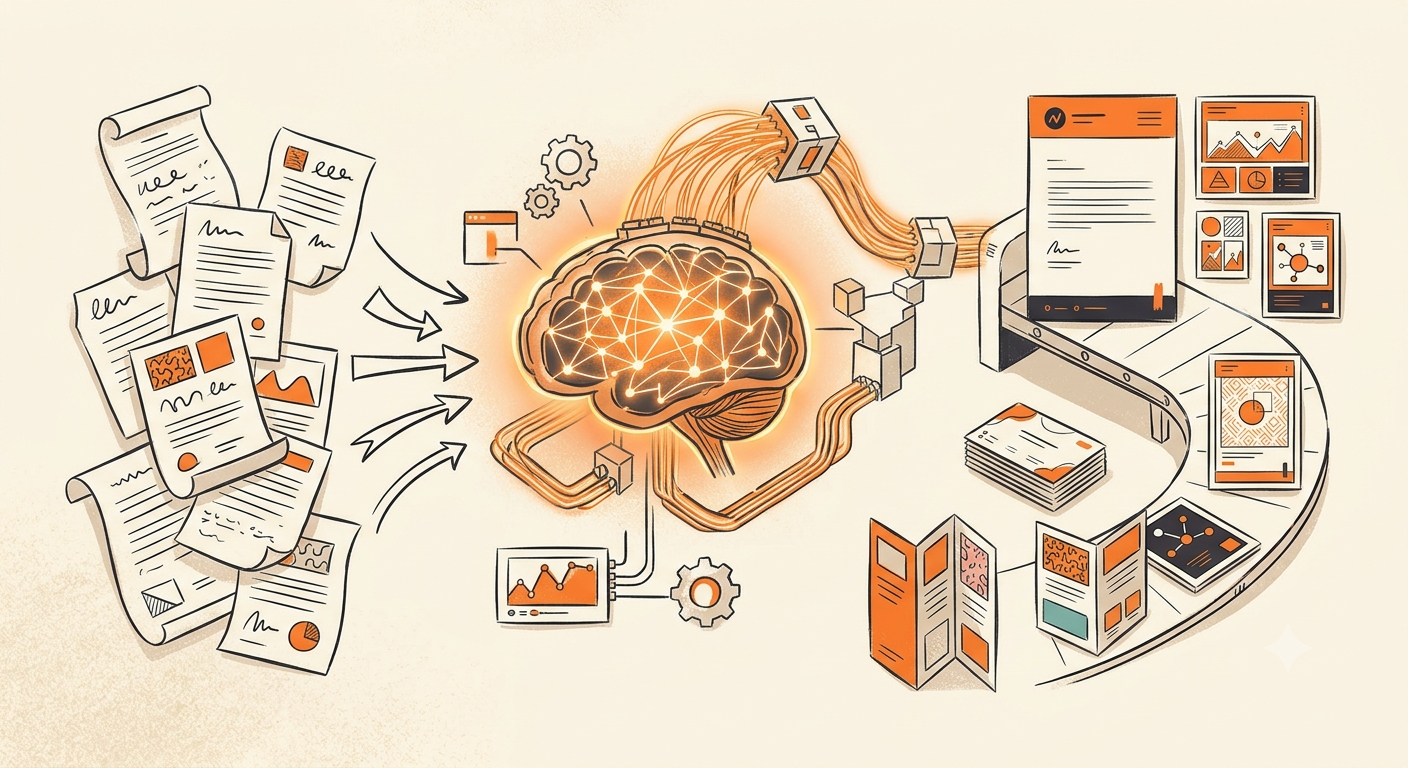
Let's demystify this. An AI print engine like NeuroInkX doesn't use generic image generation (that's a different technology entirely). Instead, it works more like an incredibly precise, infinitely patient production designer:
1. Brand Rule Ingestion
First, the system ingests your complete brand identity — not as a PDF guideline, but as code-level constraints. Every color value, every font weight, every spacing rule, every logo usage requirement becomes a hard rule that cannot be broken. This isn't a "suggestion" system — it's an enforcement engine.
2. Content-First Layout Generation
When a user inputs content (text, images, data), the engine doesn't start with a blank canvas. It starts with typographic and compositional rules that determine the optimal layout. Headline hierarchy, body text flow, image placement, whitespace distribution — all calculated based on the content itself and the brand's visual language.
3. Print-Ready Output Pipeline
Here's where it gets powerful. The engine doesn't just produce a pretty visual — it produces a production-ready file. That means CMYK color profiles matched to your specific print vendor. Bleed and trim marks at industry-standard specifications. Vector assets where possible, high-resolution rasters where necessary. Correct DPI for the target print size. Multiple format exports simultaneously.
What This Means for Designers
If you're a designer reading this, here's the honest truth: AI print engines will change your job. But not in the way the fear-mongering headlines suggest. Here's what actually changes:
- You stop being a production artist — No more late nights reformatting the same poster for 5 different sizes. The engine handles that in seconds.
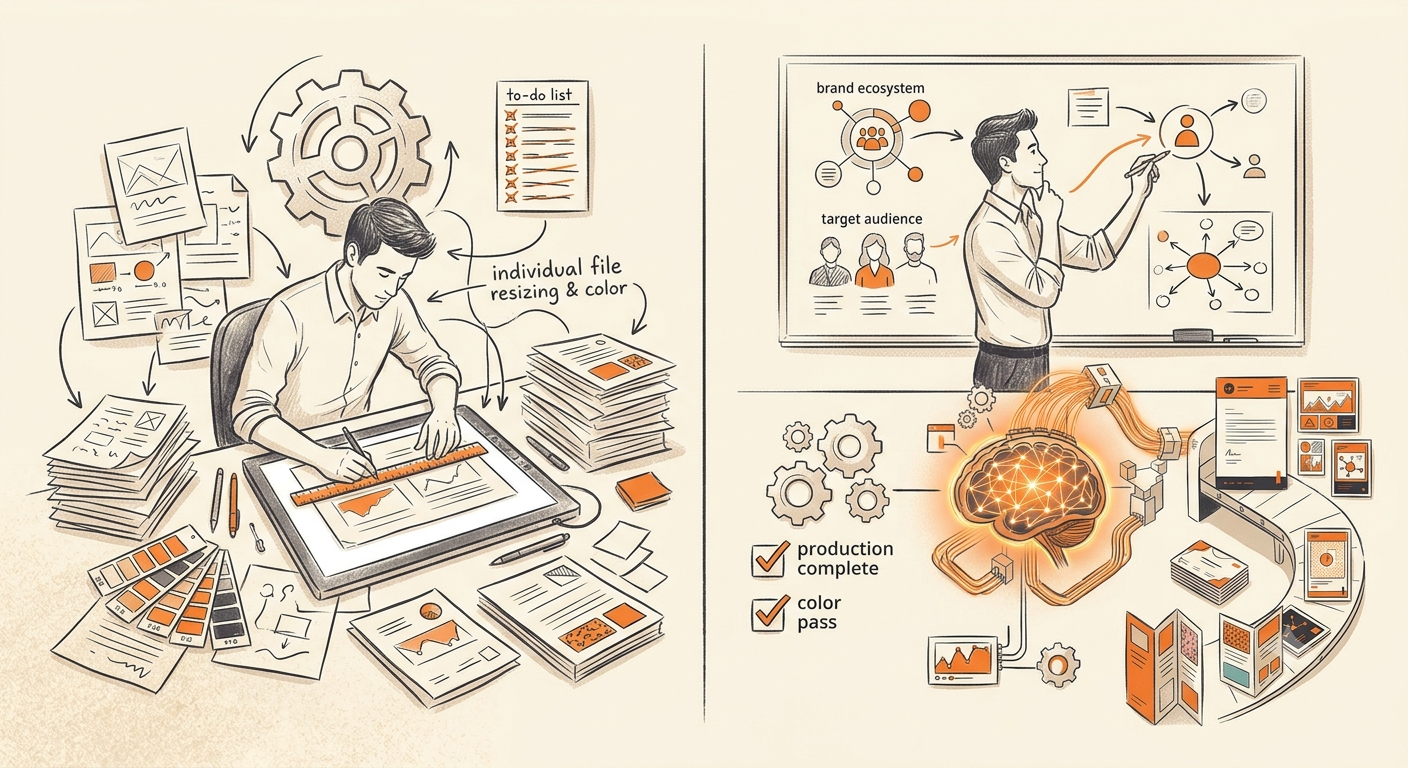
- You become a brand architect — Your role shifts from "making things" to "defining the system that makes things." You set the rules, the grid, the hierarchy. The AI executes them perfectly, every time.
- You focus on strategy — With production work automated, you spend your time on what actually moves the needle: brand strategy, creative direction, visual innovation.
- You become more valuable — When a single designer can define a system that produces thousands of consistent assets, that designer's strategic value increases dramatically.
The Results: Real Numbers
Early adopters of AI print engines are seeing dramatic improvements across the board:
- 10x faster asset production — What took a designer 4 hours now takes 5 minutes.
- Zero brand inconsistencies — Not "fewer mistakes" — literally zero. Because the system doesn't allow them.
- 85% reduction in revision cycles — When the output is brand-compliant by definition, there's nothing to fix.
- 60% cost savings — Fewer designer hours, zero reprints, no revision overhead.
The Future Is Collaborative, Not Competitive
The most exciting future isn't one where AI replaces designers. It's one where designers define the rules and AI executes them at scale. Where a brand system designed by one talented designer can produce thousands of perfectly consistent assets across every channel and format. Where creativity is amplified, not automated.
That future isn't 10 years away. It's here now. And the designers who embrace it — who see AI as a power tool rather than a threat — are the ones who will define the next era of brand design.
The question isn't whether AI will change print design. It already has. The question is whether you'll be the one directing it, or watching from the sidelines.